Plan A
Morning
Mon–Fri · 8:00 AM – 2:00 PM
~17 weeks (~4 months)
$500down payment
Weekly payments17 × $300
Total cost$5,600
Professional tool kit included
Enroll in morningPrograms / 500-Hour Master Barber
New York requires 500 hours of state-approved training before you can sit for the barber licensing exam. This is the full route for career-changers starting from zero — the same 500 hours the state counts, taught hands-on with real clients, then aimed squarely at passing the New York State Board exam and walking into a shop as a working barber.
NYS-Licensed 500 Hours ~4 Months Full-Time Weekly Payment Plans Se Habla Español
Schedules & Payment Plans
The 500 hours are identical on every plan; the only real choice is pace versus cost. Every plan starts with a small down payment of $200–$500, then continues on weekly payments while you train — so you pay as you go instead of all at once.
Plan A
Mon–Fri · 8:00 AM – 2:00 PM
~17 weeks (~4 months)
$500down payment
Professional tool kit included
Enroll in morningPlan B
Mon–Fri · 2:00 PM – 8:00 PM
~17 weeks (~4 months)
$200down payment
Plan C
Sat & Sun · Flexible hours
~27 weeks (~6–7 months)
$200down payment
A $100 non-refundable registration fee is included in the down payment on every plan.
New cohorts begin the first Monday of every month — next start soon. Compare pace side by side on the schedules page.
The Program at a Glance
Everything that matters about the 500-hour Master Barber program in four figures — hours required, how fast you can finish, when classes begin, and what tuition starts at.
What You'll Learn
The point of 500 hours is not seat time — it is a portfolio of cuts you can charge for on day one. You train on real, paying-clinic clients under instructor supervision, so by graduation a fade, a lineup or a hot-towel shave is muscle memory, not theory.
Low, mid and high fades, classic tapers, bald fades and seamless blending — the foundation of nearly every modern NYC haircut and the skills clients ask for by name.
Straight-razor lineups, edge-ups and detailing that give a cut its crisp, finished shape. Precision razor control is what separates a trained barber from a hobbyist.
Beard trims, sculpting, shape-ups and grooming — a fast-growing, high-margin service that turns a single-chair barber into a full-service one.
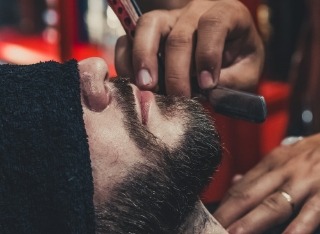
The traditional wet shave, hot-towel prep and facial massage — premium services that command premium tickets and set a shop apart.
Pompadours, Caesars, afros, flat tops, scissor-over-comb, blowouts and classical haircutting across every hair type you'll meet on an NYC clinic floor.
Sterilization, sanitation, barber law and shop management — the theory New York tests you on — then dedicated New York State Board exam preparation, written and practical.
Want the full breakdown? See where these skills can take your career or read how long barber school really takes.
The Timeline
Four phases carry you from your first day in the classroom to a licensed barber working the chair. The order is deliberate: theory first, then the floor, then the exam.
Your opening weeks cover the fundamentals New York tests you on: sanitation, sterilization, barber law, shop management and barbering history — the written half of the State Board exam.
The bulk of your hours are hands-on with real clients — fades, tapers, razor work, beard trims, hot-towel shaves and facial massage under instructor supervision on the clinic floor.
The final stretch is dedicated to New York State Board exam preparation, both practical and written, so you walk into test day ready instead of guessing.
You pass the State Board exam, receive your Master Barber license, and step into a New York shop as a working professional — or start building toward your own chair.
Why This Route Works
“A license is the credential employers and shop owners actually look for. Four months of the right 500 hours is the shortest honest distance between where you are now and a chair you get paid to stand behind.”
Barbering is one of the most accessible skilled trades to break into — low entry requirements, fast licensing, and income that scales with your skill and your book of clients. In New York City, demand for trained barbers is steady, tips are real, and the ceiling is yours to raise: employee, booth renter, or shop owner. See how the timeline compares to other career paths.
Paying for It
Between weekly payment plans, veterans' benefits and vocational-rehabilitation funding, most students find a way to make the 500-hour program work. Here is where to start.
Start with $200–$500 down and pay weekly as you train, so tuition never lands as one lump sum. See the full breakdown on the tuition & funding page.
Eligible veterans may use GI Bill® benefits toward barber training. Learn what's covered and how to start on the veterans & GI Bill® page.
New Yorkers with a documented disability may qualify for ACCES-VR funding toward tuition, tools and books. Check eligibility on the ACCES-VR page.
Common Questions
Your Next Step
You have the timeline, the cost and the requirements. The next step is picking a start date and a schedule. New cohorts begin the first Monday of every month — next start soon.
About the Program
Across roughly six months of instruction, students spend two weeks in barber theory — sanitation, sterilization, the history of the trade, New York barber laws and the fundamentals of shop management. From there the work moves onto the clinic floor.
ABI puts a steady flow of real clients in front of every student and teaches the craft of shaving, facial massage and hair styling — classic tapers, fohawks, pompadours, baldies, caesars, low fades, mid fades, high fades, high-top fades, afros, flat tops, razor lineups, shampoos, classical haircuts, beard trims, shape-ups, blowouts, mohawks — alongside dedicated preparation for the New York State Board Exam.
Once the program wraps, every student meets with our job-placement office to walk through open opportunities and start their career on solid footing.
Skills You'll Learn
Every skill and technique you'll need to stand apart on the floor. Real clients, real practice, from day one.
Plus dedicated preparation for the New York State Board Exam and job-placement support at the end of the program.
Classes begin the first Monday of each month
Next class starts soon. Seats fill fast — start your barber school enrollment, request a call, or speak with admissions in English or Spanish.